The Slow Return to Presence Nervous System Map
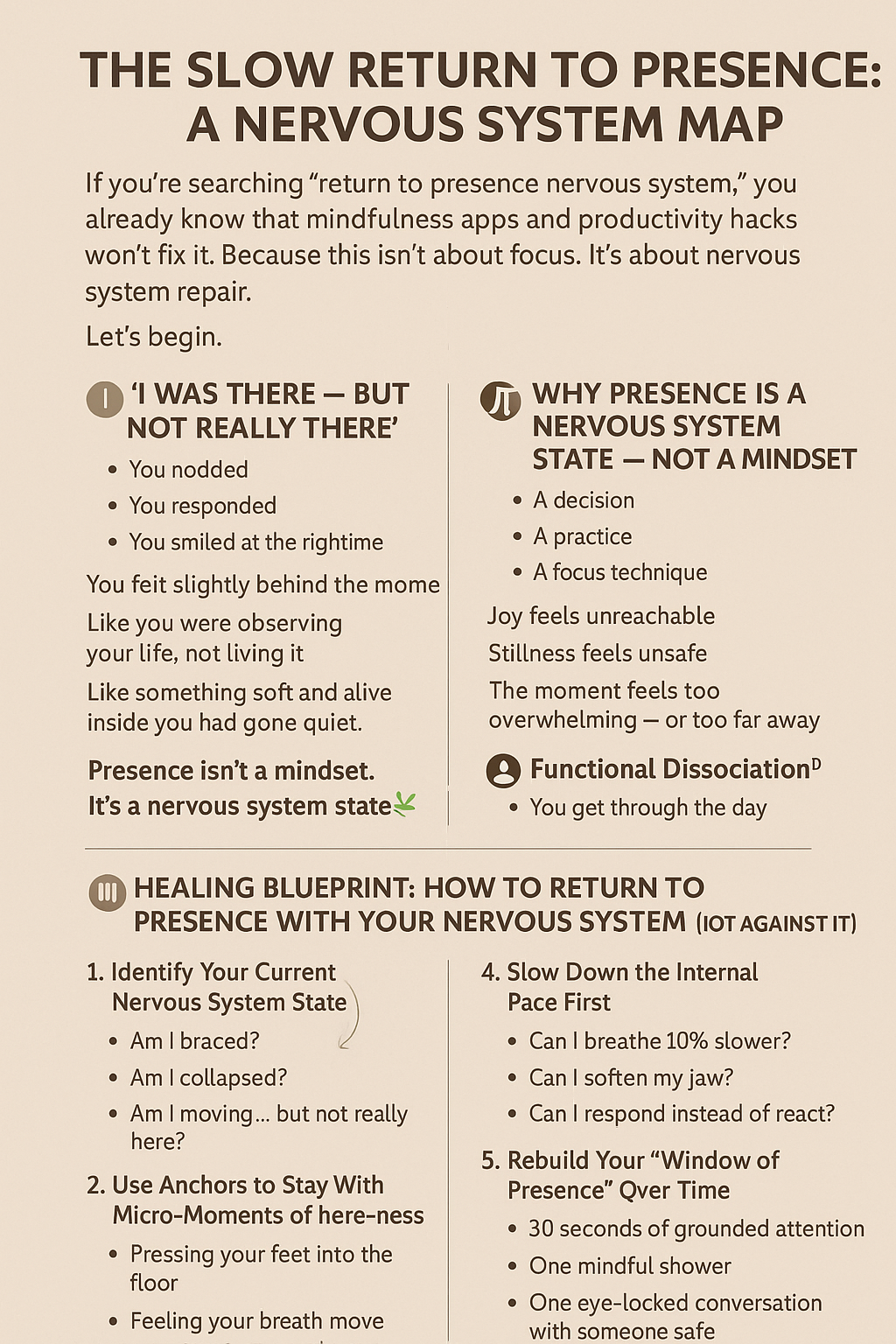 return to presence nervous system healing
🧠 You’re Not Distracted — You’re Disconnected. Let’s Come Home.
**If you’re searching “return to presence nervous system,”**you already know that mindfulness apps and productivity hacks won’t fix it.
Because this isn’t about focus.
It’s about nervous system repair.
Let’s begin.
🌟 I. “I Was There — But Not Really There”
You were in the room.
-
You nodded.
-
You responded.
-
You smiled at the right time.
But inside?
-
You felt slightly behind the moment
-
Like you were observing your life, not living it
-
Like something soft and alive inside you had gone quiet
You weren’t in pain — but you weren’t present.
You could hear what someone said… but not really feel it.
You could sit with your coffee… but not taste it.
And the worst part?
You didn’t know how to get back.
You wanted to return.
To presence.
To warmth.
To you.
But presence didn’t arrive just because you tried harder.
And that’s when you discovered the truth:
**Presence isn’t a mindset.****It’s a nervous system state.**🌿
🧠 II. Why Presence Is a Nervous System State — Not a Mindset
🧬 You Can’t “Think” Your Way Into Presence#
We’re taught that presence is:
-
A decision
-
A practice
-
A focus technique
But if your nervous system is dysregulated, none of that will land.
Why?
Because your body is still prioritizing survival over presence.
In this state:
-
Joy feels unreachable
-
Stillness feels unsafe
-
The moment feels too overwhelming — or too far away
This isn’t mindset failure.
It’s biological protection.
🛡️ Presence Lives in the Ventral Vagal State#
According to Polyvagal Theory:
- Presence lives in the ventral vagal system — the branch of your nervous system that says:
“You’re safe, connected, and here.”
But if you’re in:
-
Fight or flight — your system is hyper-alert
-
Freeze — you feel foggy, numb, detached
Then you can’t drop into the present moment — because your body doesn’t believe it’s safe to.
Presence disappears not because you’re weak.
But because your body is still on alert.
“If you’ve been feeling numb, disconnected, or emotionally flat — this deeper guide on how to heal dissociation and reconnect with who you are can help you go even further.”
🔄 Most High-Functioning Adults Are in “Functional Dissociation”#
You get through the day.
You work, respond, perform — but you’re not inside it.
This “functional dissociation” is incredibly common after:
-
Long-term burnout
-
Emotional shutdown
-
Trauma
-
Hyper-productivity culture
And the world praises you for it.
But you feel hollow — because your presence never caught up with your performance.
The good news?
You can return.
But not by trying harder.
**You return to presence by working with your nervous system — not against it.**🌿
🌱 III. Healing Blueprint: How to Return to Presence With Your Nervous System (Not Against It)
You don’t have to force focus.
You have to create a nervous system environment where presence becomes possible.
Here’s how to begin:
🌿 1. Identify Your Current and Return to Presence Nervous System State#
Before presence… comes awareness.
Ask yourself:
- “Am I braced?”
- “Am I collapsed?”
- “Am I moving… but not really here?”
You might be in:
-
Fight/Flight: anxious, fidgety, restless
-
Freeze: numb, flat, spaced out
-
Fawn/Perform: busy, smiling, disconnected
There is no shame in any state.
You’re not “doing it wrong.”
You’re surviving.
And now… we begin returning.
📖 2. Use Anchors to Stay With Micro-Moments of Here-ness#
Presence starts with 3 seconds — not 30 minutes.
Try:
-
Pressing your feet into the floor
-
Feeling your breath move without changing it
-
Noticing texture with your fingers
-
Listening to ambient sounds without naming them
This isn’t about focus.
It’s about orientation — telling your body,
“This moment is safe enough to enter.”
🌸 3. Slow Down the Internal Pace First#
Don’t just clear your calendar — clear your internal speed.
Pause.
Then ask:
- “Can I breathe 10% slower?”
- “Can I soften my jaw?”
- “Can I respond instead of react?”
Let slowness happen inside you
before you expect it outside you.
That’s where presence blooms.
🧘♀️ 4. Rebuild Your “Window of Presence” Over Time#
Your ability to stay present — especially after dissociation — takes time to stretch.
Start with:
-
30 seconds of grounded attention
-
One mindful shower
-
One eye-locked conversation with someone safe
Then rest.
Then return again.
**Presence isn’t about perfection.**It’s about increasing your nervous system’s capacity to stay with life.
🌄 5. Practice Co-Presence Before Solo Presence#
Presence is contagious.
When your system doesn’t trust you yet, borrow someone else’s calm.
Try:
-
Sitting with a friend in silence
-
Letting your pet regulate you
-
Attuning to a therapist’s grounded tone
-
Walking with someone who doesn’t rush you
Being with others often re-teaches your body how to be with yourself.🌿
🧠 Bonus Support: Therapy for Nervous System Regulation and Presence
If you’ve been “almost here” for too long —
if your body still doesn’t trust the moment fully —
That’s not failure.
That’s unresolved survival state.
Professional CBT-based therapy can help you:
-
Regulate safely
-
Exit chronic functional dissociation
-
Return to presence without pressure
We recommend Online-Therapy.com, a CBT platform supporting trauma-aware nervous system work.
💡 Use code THERAPY20 to get 20% off your first month. **Online-Therapy.com**🌿
You don’t have to force your way into the present.
You just have to invite your body back in — and stay long enough to be received.
📚 IV. FAQ Section: Nervous System & Returning to Presence
❓ Why can’t I just decide to be more present?#
Because presence is not a thought — it’s a regulated state.
It becomes available when your nervous system feels safe enough to stay.
❓ How do I know if I’m dissociating vs. just distracted?#
Dissociation feels flat, far away, or floaty — often with no emotion at all.
Distraction is usually more energetic or scattered, with emotion still accessible.
❓ Can I return to presence while still in burnout?#
Yes — but in **micro-moments.**Even 10 seconds of grounded attention is real.
The nervous system expands from there.
❓ What’s one tool I can use today?#
Feel your feet.
Touch something textured.
Breathe slowly.
Then say out loud: *“I’m here now.”*Even if it doesn’t feel true — it plants a seed.
🫀 The Moment I Stopped Trying to Be Present — And Started Letting Myself Arrive#
“Presence didn’t come when I focused harder. It came the moment I stopped trying to fix myself and finally said, ‘It’s okay to land.’”
*For the longest time, I thought presence was about discipline.**Focus harder.**Cut the distractions.*Be more mindful, dammit.
*And every time I failed to “stay present,” I blamed myself.**I thought I was weak — lazy — too digital, too damaged.**But the truth was quieter.**My body wasn’t distracted.*It was scared.
*I wasn’t zoning out because I was careless.*I was floating because the ground didn’t feel safe yet.
The shift didn’t happen during a meditation.It happened when I wrapped a blanket around my shoulders and whispered,“You can stop bracing now.”
*It happened when I touched the bark of a tree and actually felt it.*When I laughed, not to be polite — but because something stirred.
*Presence returned not with force, but with permission.**And if you’re still half-here, half-floating?**Don’t fight harder.**Sit.**Breathe.Tell your body,“You’re allowed to arrive now.”**It might not happen all at once.*But trust me — you’ll know the moment you come home.
Recommended Digital Wellness & Focus Tools#
To support nervous system regulation, overcome phone-checking compulsions, and establish deep work focus, our testing team recommends pairing behavioral boundaries with tactile, low-stimulation hardware:
Calculate your net savings on focus gear with our Smart Deal & Double-Discount Calculator, or explore all active price drops in the Curated Deals Hub.
Countdown 2 Savings Editorial Desk
Our team monitors 50+ retail databases, tracks historical price floors, and tests consumer hardware in production environments.