How Overstimulation and Focus Relate with ADHD — Even If You Don’t Have It
 overstimulation and focus recovery
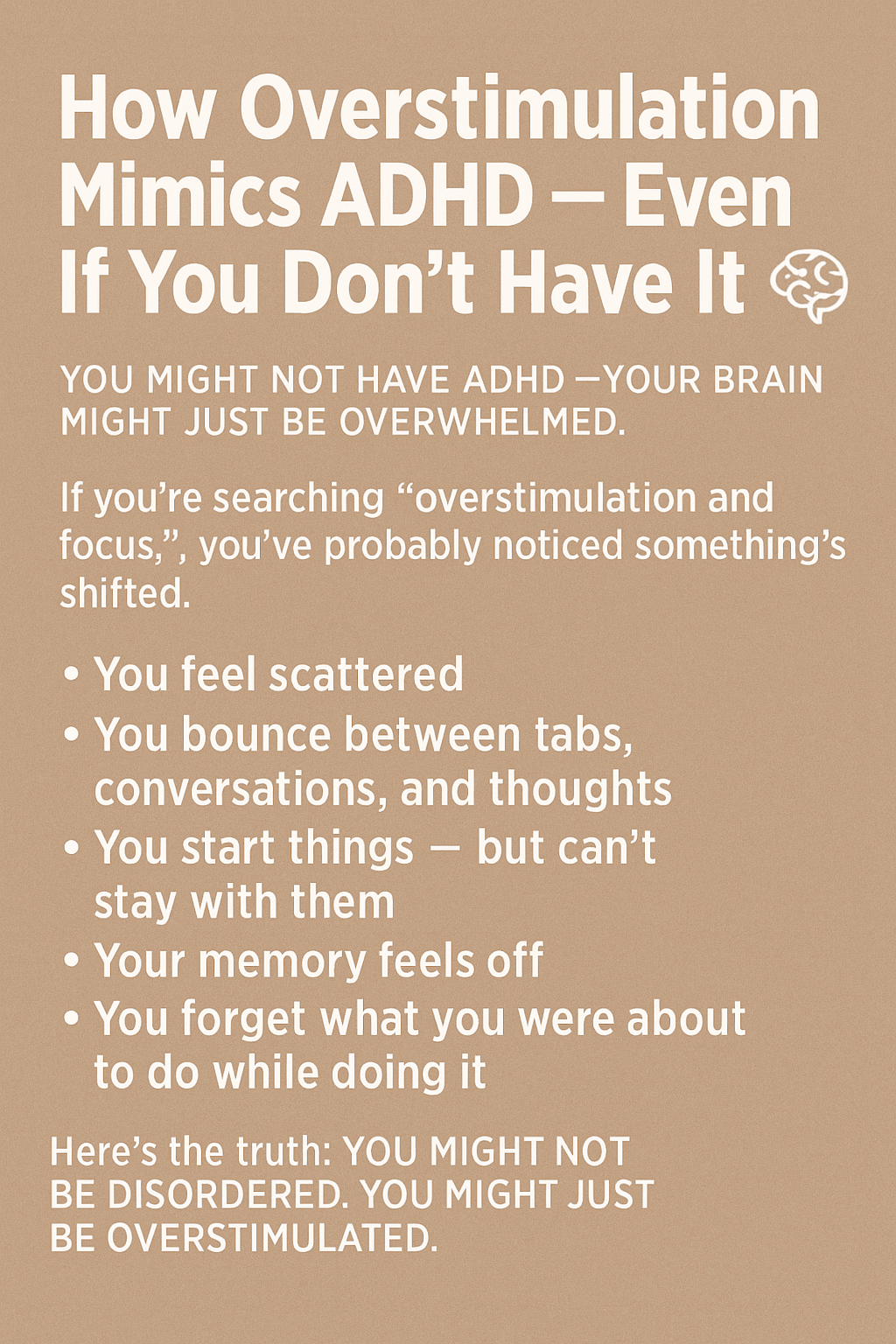
🧠 You Might Not Have ADHD — Your Brain Might Just Be Overwhelmed
**If you’re searching “overstimulation and focus,”**you’ve probably noticed something’s shifted.
You used to be able to finish tasks.
Sit still. Read without skimming. Think without switching apps every five minutes.
Now?
-
You feel scattered
-
You bounce between tabs, conversations, and thoughts
-
You start things — but can’t stay with them
-
Your memory feels off
-
You forget what you were about to do while doing it
You’ve wondered:
“Do I have ADHD?”“Has my brain changed?”“Why do I feel mentally allergic to stillness?”
And maybe you’ve never had a diagnosis.
Maybe these symptoms are new.
Maybe it all began… when your screen time skyrocketed.
Here’s the truth:
You might not be disordered. You might just be overstimulated.
Let’s talk about it.
🧠 II. How Overstimulation Hijacks Focus
🧬 ADHD Is Neurological — But Overstimulation Mimics It Closely#
People with ADHD are born with different brain wiring.
But chronic digital overwhelm can mirror those symptoms — and trigger them even in neurotypical brains.
Here’s how:
-
Constant app-switching, tab-hopping, and short-form content trains your brain to expect rapid novelty
-
This floods your system with dopamine spikes — until stillness feels painful
-
When you try to focus on one thing?
Your brain revolts. It craves something faster.
🔁 Overstimulation Creates ADHD-Like Symptoms, Such As:#
-
Can’t finish what you start
-
Forget what you walked into the room for
-
Overcommit, then get paralyzed
-
Struggle to follow through on plans
-
Feel impulsive, restless, and chronically distracted
-
Panic when you’re “off grid” (no music, no tabs, no input)
And even if you don’t have ADHD, this behavior pattern feels nearly identical.
Because your focus system is overloaded — not lazy.
Not broken.
Just running on a loop that your brain was never meant to maintain.
“For a deeper look into how dopamine hijacks focus and why it’s not your fault, explore the full breakdown in The Real Reason You Can’t Focus Anymore. ”
🛡️ Your Nervous System Is Also in Survival Mode#
Overstimulation doesn’t just exhaust your brain — it activates your body.
You may also experience:
-
Increased heart rate
-
Shallow breath
-
Irritability
-
Hypervigilance
-
Anxiety in stillness
That’s not just mental fatigue.
That’s your nervous system saying:
“This much input is unsafe — and we need to keep moving to stay ahead of it.”
But the more you run, the less focus you have.
And that’s where we begin the healing.🌿
🌱 III. Healing Blueprint: How to Calm the Noise and Reclaim Your Focus
You don’t need a diagnosis to deserve clarity.
You just need to give your brain a chance to come back to center.
Here’s how.
🌿 1. Stop Pathologizing What’s Actually Adaptive#
If your brain feels scattered — it’s not necessarily because something’s wrong.
It may be responding perfectly to a world that’s been overwhelming it.
Say to yourself:
“This isn’t dysfunction. This is survival.”
And survival is something you can unwind —
with safety, rhythm, and slowness.
📖 2. Restore Your Sensory Floor#
If everything feels like “too much,”
it’s because your sensory baseline is flooded.
Try this once a day:
-
No headphones
-
No talking
-
No screens
-
Just 10 minutes of nothing loud, nothing fast
It might feel boring at first. Or itchy. Or “unproductive.”
That’s okay.
You’re re-training your nervous system to experience peace as safe.
🌸 3. Anchor into One Task Per Window#
Your brain can’t heal focus if it never stops switching.
Use simple containers:
-
25 minutes → One intention only
-
Then: 5-minute transition (movement, water, breath)
-
No stacking (don’t sneak in a text or a scroll while “waiting”)
Your focus doesn’t come back through *effort.*It comes back through boundaries.
🧘♀️ 4. Rebuild Trust in Stillness#
Stillness might feel like danger right now.
That’s trauma stored in speed.
So don’t start with full silence.
Instead:
-
Listen to ambient music
-
Sit with candlelight
-
Rock gently
-
Trace your breath with one hand on your chest
This is how stillness stops feeling like abandonment —
and starts feeling like home.
🌄 5. Use Slow Stimulus to Rewire Focus#
Overstimulation trains your brain to expect spikes.
You’ll need the opposite to rebuild attention span.
Try:
-
Reading one printed page (slowly)
-
Drawing, painting, folding laundry
-
Writing a paragraph without editing
-
Going for a walk with no destination
These aren’t “downtime.”
They’re rewiring therapy.
Every moment of slow input is one step away from mental chaos —
and back toward cognitive calm.🌿
🧠 Bonus Support: Therapy for Overstimulation, Focus, and Nervous System Healing
If your mind is always racing,
if silence feels terrifying,
if you can’t stop multitasking long enough to breathe —
It’s not weakness.
It’s a signal.
We recommend Online-Therapy.com, a CBT-based platform that helps with:
-
Overstimulation patterns
-
Focus re-integration
-
Nervous system regulation
-
Building presence without panic
💡 Use code THERAPY20 to get 20% off your first month. Online-Therapy.com 🌿
You don’t need more focus hacks.
You need space.
And support.
And softness.
📚 IV. FAQ Section: Overstimulation and Focus
❓ Can overstimulation really mimic ADHD?#
Yes — especially in digitally overwhelmed brains.
It creates restlessness, forgetfulness, and impulse-seeking behavior nearly identical to ADHD.
❓ Should I still get tested for ADHD?#
If symptoms persist or began early in life, testing is valuable.
But even without a diagnosis, nervous system repair supports focus.
❓ Why do I feel panicked in silence now?#
Because your brain associates silence with danger or emptiness.
You’ve been trained to avoid stillness — not because you’re weak, but because you adapted.
❓ How do I calm down without using screens?#
Start small:
Music, sunlight, slow breathing, walking.
You’re not removing stimulation — you’re replacing spikes with steadiness.
🫀 When Stillness Felt Like Suffocation#
“I used to think something was wrong with me. Now I know — my brain was just overwhelmed by everything, all the time.”
*There was a time I couldn’t sit in silence for more than 30 seconds without grabbing my phone.**I’d open my laptop to focus — and 45 minutes later, I’d have 19 tabs open, none finished, none useful.**I’d forget what I walked into a room for, mid-sentence.**And the scariest part wasn’t the distraction…*It was that I couldn’t stop it.
*I Googled ADHD symptoms more times than I can count.**I thought I needed a new planner, a new app, a new version of myself.**But what I really needed?*Was a pause — the kind that doesn’t scream for your attention.
*When I finally sat with the stillness — no music, no podcast, no screen —**it felt like panic at first.**Like withdrawal.**But under that noise was something quiet and raw…*something that had been waiting to be felt for years.
*It wasn’t that I had no focus.**It’s that I had never learned how to feel safe enough to use it.**If that’s you right now, hear me:**You’re not broken. You’re overstimulated.**And your clarity isn’t gone — it’s just buried under noise.**Start with breath.**Start with one page.**Start with one deep, human pause.*That’s how your focus comes home.
Recommended Digital Wellness & Focus Tools#
To support nervous system regulation, overcome phone-checking compulsions, and establish deep work focus, our testing team recommends pairing behavioral boundaries with tactile, low-stimulation hardware:
Calculate your net savings on focus gear with our Smart Deal & Double-Discount Calculator, or explore all active price drops in the Curated Deals Hub.
Countdown 2 Savings Editorial Desk
Our team monitors 50+ retail databases, tracks historical price floors, and tests consumer hardware in production environments.