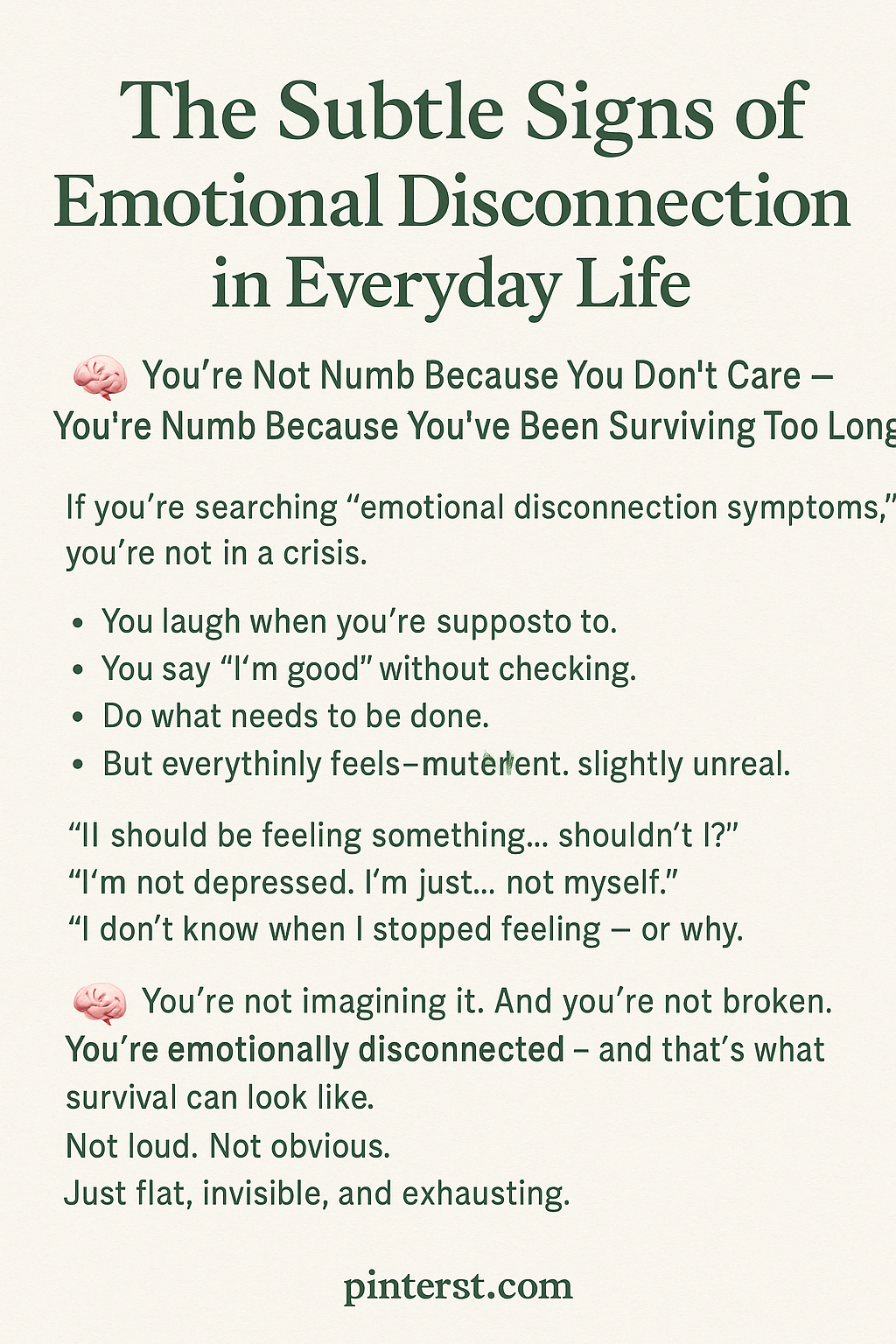
The Subtle Signs of Emotional Disconnection in Everyday Life
 emotional disconnection symptoms nervous system healing
🧠 You’re Not Numb Because You Don’t Care — You’re Numb Because You’ve Been Surviving Too Long
**If you’re searching “emotional disconnection symptoms,”**you’re probably not in a crisis.
You’re not sobbing on the floor.
You’re not visibly unraveling.
You’re just… not here.
-
You laugh when you’re supposed to.
-
You say “I’m good” without checking.
-
You do what needs to be done.
But everything feels… muted. Distant. Slightly unreal.
You think:
“I should be feeling something… shouldn’t I?”“I’m not depressed. I’m just… not myself.”“I don’t know when I stopped feeling — or why.”
You’re not imagining it.
And you’re not broken.
You’re emotionally disconnected — and that’s what survival can look like.
Not loud. Not obvious.
Just flat, invisible, and exhausting.
🧠 II. What Emotional Disconnection Looks Like (But No One Talks About)
🧬 Disconnection Isn’t Always Dramatic — It’s Often Invisible#
Emotional disconnection is what happens when your nervous system decides that feeling is too risky.
Not because you’re weak.
But because life — trauma, overstimulation, burnout, performance pressure — has taught your body that it’s safer to go numb than to feel.
It’s a freezing state dressed in productivity.
It’s a protective silence — not failure.
🔍 Subtle, Everyday Symptoms of Emotional Disconnection:#
-
You smile, but it doesn’t feel like yours
-
You say “I’m fine” before you even pause to check
-
You struggle to name how you feel at all
-
Joy doesn’t reach you — it just passes through
-
Sadness doesn’t come out — it just tightens inside
-
You avoid stillness because something inside feels missing
-
You feel more like a mirror than a person
You’re not ungrateful.
You’re not unfeeling.
You’re just unreachable right now — even to yourself.
But that can change.🌿
“To understand how chronic screen use disconnects you from your own emotions and identity, read: How to Feel Like Yourself Again After Years of Digital Numbing.”
🌱 III. Healing Blueprint: How to Gently Reconnect With Your Emotions
You don’t need to feel everything all at once.
You just need to give your emotions a safe place to land.
Here’s how to begin reconnecting — softly, without overwhelm.
🌿 1. Start With Naming, Not Fixing#
You don’t need to analyze what you feel.
You just need to acknowledge what’s there — even if it’s “nothing.”
Try saying:
-
“I feel flat.”
-
“I’m not sure what I feel right now.”
-
“Something is quiet inside me.”
The goal is presence — not performance.
You’re building emotional fluency one word at a time.
📖 2. Use External Anchors to Activate Internal Sensation#
Your body responds to **stimulus before stories.**So when emotions feel unreachable, start with the senses.
Try:
-
Holding something warm
-
Listening to emotionally evocative music
-
Using a scented oil or calming texture
-
Looking at soft light or color
Let your system notice safety before you ask it to feel.
🌸 3. Ask Low-Pressure Check-In Questions#
Skip the “What’s wrong with me?” spiral.
Instead, ask:
-
“What did I notice today?”
-
“What made me feel 1% more real?”
-
“What did I want to say but didn’t?”
You’re not digging for wounds.
You’re inviting your inner world to reveal itself — gently.
🧘♀️ 4. Let Emotional Truth Return Without Forcing It#
You don’t need to cry today.
You don’t need to heal everything in a journal entry.
Let your body know:
“You can feel again — when you’re ready.”
That might look like:
-
Sitting with music and noticing what stirs
-
Watching a memory rise and just being with it
-
Breathing into a tight space and not rushing to explain it
This isn’t breakthrough.
This is emotional companionship.
🌄 5. Repeat Until Numbness Starts to Shift#
Emotional disconnection dissolves through:
-
Rhythm
-
Repetition
-
Safety
Even if you feel nothing today, the act of showing up for your inner world creates the space for feeling to return.
Not on command.
But on invitation.🌿
🧠 Bonus Support: Therapy for Emotional Disconnection, Freeze States & Self-Reconnection
If your life looks fine but feels hollow —
if you function but don’t feel —
you’re not “too far gone.”
You’re emotionally disconnected — not broken.
We recommend Online-Therapy.com, a CBT-based platform that helps with:
-
Emotional numbness
-
Nervous system regulation
-
Self-expression
-
Feeling again without flooding
💡 Use code THERAPY20 to get 20% off your first month. Online-Therapy.com 🌿
Your emotions haven’t left you.
They’re waiting — for a safe way back in.
📚 IV. FAQ Section: Emotional Disconnection Symptoms
❓ What are the signs of emotional disconnection?#
Feeling flat, numb, joyless, or “not yourself” even when life seems fine. You may say you’re “okay” — but you don’t feel anything.
❓ Why can’t I feel emotions anymore?#
Often due to long-term stress, trauma, or digital overstimulation. Your nervous system may have shut down access to emotion to protect you.
❓ Can I feel again even if I’ve been numb for years?#
Yes. With consistency, safety, and micro-moments of connection, emotional access can return — often faster than you think.
❓ How do I start reconnecting?#
Start with breath, sensory rituals, honest check-ins, and tiny expressions. Feeling returns in layers — not all at once.
🫀 I Was “Fine” for So Long, I Forgot What Feeling Felt Like#
“Numb isn’t the absence of pain. It’s the silence after surviving too much, too quietly.”
*For the longest time, I thought I was doing okay.**I said “I’m good” so automatically, I forgot to ask if it was even true.**I smiled when I was supposed to.**Laughed when others did.**Checked boxes. Showed up. Functioned.**But deep down?*I wasn’t there.
*There were days I’d sit on the couch, phone in hand, scrolling endlessly —**not because I was entertained…**but because I didn’t know what else to feel.**Joy didn’t land.**Sadness didn’t move.*Everything was… muted.
*It didn’t look like depression.**It didn’t look like crisis.*It just felt like floating — like life had texture, and I was watching it behind glass.
*The truth is, I hadn’t failed at feeling.**My body had learned to freeze — to stay safe by going silent inside.**And that silence?**It took time to unlearn.**Not with big breakthroughs, but with tiny, ordinary moments:**music that stirred me,**a hot mug in my hands,*naming “I feel nothing” without guilt.
*If you’re reading this from the hollow place — I get it.**You’re not broken.**You’re on your way back.**And even if you don’t feel it yet…*part of you is already home.
Recommended Digital Wellness & Focus Tools#
To support nervous system regulation, overcome phone-checking compulsions, and establish deep work focus, our testing team recommends pairing behavioral boundaries with tactile, low-stimulation hardware:
Calculate your net savings on focus gear with our Smart Deal & Double-Discount Calculator, or explore all active price drops in the Curated Deals Hub.
Countdown 2 Savings Editorial Desk
Our team monitors 50+ retail databases, tracks historical price floors, and tests consumer hardware in production environments.