Why You Don’t Recognize Myself Anymore (And How to Start Rebuilding)
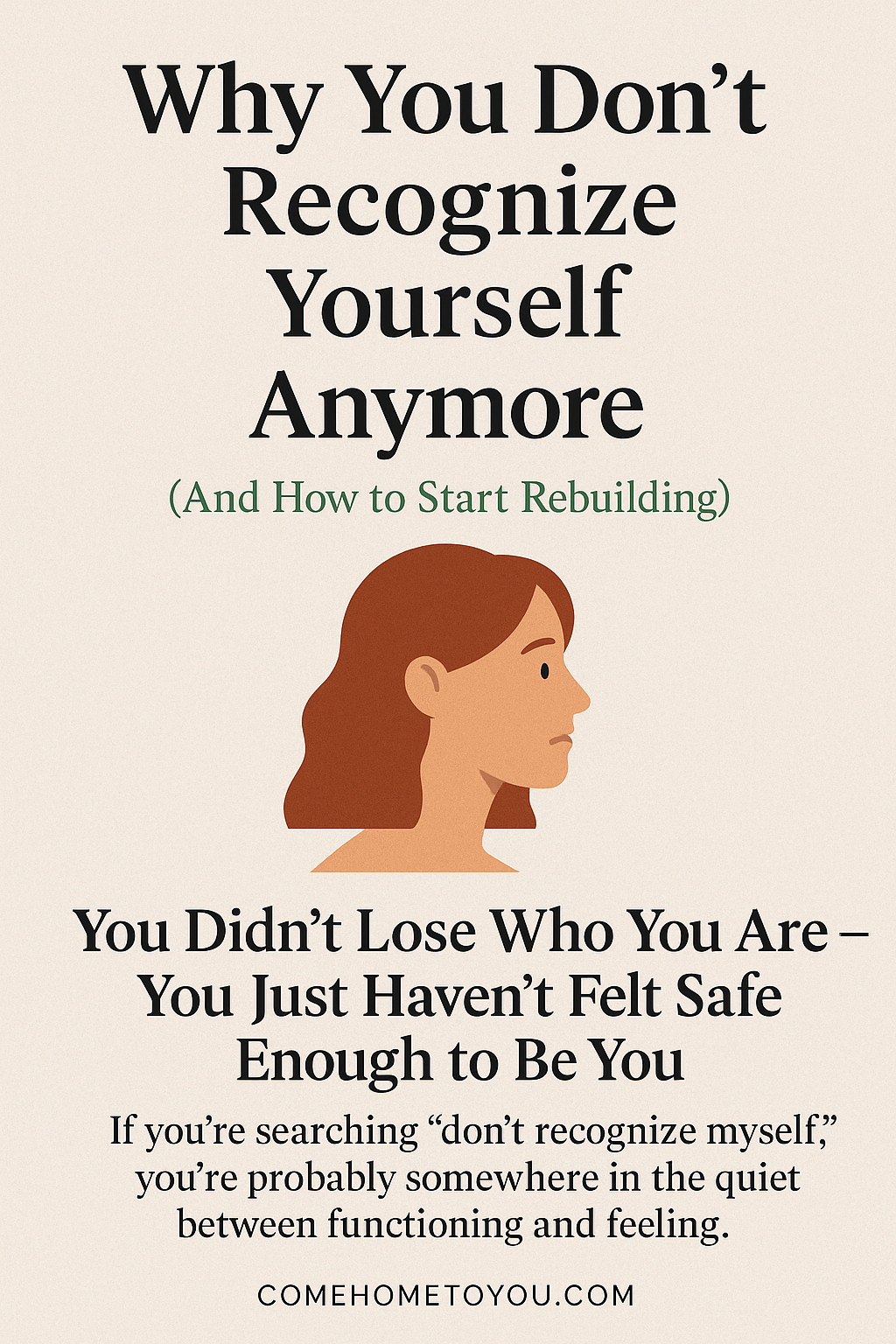 don’t recognize myself emotional reconnection guide
🧠 You Didn’t Lose Who You Are — You Just Haven’t Felt Safe Enough to Be You
**If you’re searching “don’t recognize myself,”**you’re probably somewhere in the quiet between functioning and feeling.
You do what you’re supposed to.
You reply to messages.
You get through the day.
But deep down?
-
You feel flat.
-
You don’t care like you used to.
-
You look in the mirror and wonder… “Who even is that?”
You scroll through your own photos and feel like a stranger.
You hear your voice in conversations, and it sounds like someone else.
And the scariest part?
“I don’t even know when this started.”
You’re not making this up.
You’re not broken.
You’re not lost.
You’re dissociated.
You’re disconnected from the self you had to shut down to survive.
And that disconnection isn’t a flaw —
It’s a nervous system freeze.
A trauma-informed adaptation.
A quiet way of saying: “I wasn’t safe being me for a long time.”
But now… you’re waking up.
And that’s where we begin.
🧠 II. Why You’ve Lost Connection to Yourself
🧬 Identity Doesn’t Just Disappear — It Dims#
Most people think identity is a fixed thing:
your personality, your job, your favorite color.
But in truth?
Identity is a relationship — with your own preferences, sensations, and truth.
And like any relationship, if it’s neglected long enough… it fades.
📱 Numbing, Overworking, and Digital Dissociation Break the Bond#
Every time you:
-
Scroll instead of feel
-
Work instead of rest
-
Numb instead of name what’s real
…you weaken your access to you.
Over time:
-
You stop making choices — you default
-
You stop exploring — you scroll
-
You stop expressing — you perform
-
You stop being with yourself — you become a ghost in your own life
And eventually?
You don’t know what you want.
You don’t know what you love.
You don’t know what would feel true anymore.
That isn’t failure.
It’s your nervous system in survival mode — conserving energy by shutting you out.
But survival is not your destiny.
And there is a way back to *you.*🌿
“To understand how chronic screen use disconnects you from your own emotions and identity, read: How to Feel Like Yourself Again After Years of Digital Numbing.”
🌱 III. Healing Blueprint: How to Start Rebuilding Who You Are
You don’t need to rediscover yourself in one big moment.
You just need to start noticing where your “yes” lives again.
Here’s how to reconnect — slowly, gently, truthfully.
🌿 1. Validate the Disconnection Without Shame#
Say it clearly:
“I feel disconnected from who I am.”
Let that be okay.
No pressure to be passionate, motivated, inspired, or “better.”
You’ve been surviving — not feeling.
And that was wise.
Now the wisdom is in returning — not rushing.
📖 2. Practice Identity Micro-Contact#
Your sense of self doesn’t reappear through thinking.
It returns through tiny self-noticings.
Try these daily prompts:
-
“What do I like right now?”
-
“What does my body want — food, movement, stillness?”
-
“What makes me feel even 1% more like me?”
You’re not trying to figure out who you are —
You’re learning how to listen again.
🌸 3. Reclaim Preference Through Action, Not Pressure#
Don’t journal about your purpose.
Pick a new song, outfit, walk path, food — and see how it lands.
Let your body tell you what it likes before your mind has to explain it.
This is how you start rebuilding agency — the power to choose, even softly.
🧘♀️ 4. Anchor Into Embodied Expression#
If you’ve dissociated, your body is holding your selfhood — quietly.
Give it expression:
-
Stretch without tracking it
-
Dance to one song a day
-
Draw, hum, cook, breathe — not for a result, but for reconnection
These aren’t tasks.
They’re ways back to your truth.
🌄 5. Let Identity Return Through Rhythm, Not Rush#
You’re not here to become someone new.
You’re here to remember who you were before the freeze.
Create small rituals that say:
-
“This is mine.”
-
“This feels like home.”
-
“This is who I am when I’m not performing.”
Let yourself feel that.
Even for five seconds at a time.
That’s not small.
That’s selfhood coming back online.🌿
🧠 Bonus Support: Therapy for Identity Loss, Numbness & Emotional Rebuilding
If you don’t know who you are anymore —
if your voice feels foreign and your heart feels silent —
you’re not lost.
You’re in reconnection.
And therapy can hold space for that.
We recommend Online-Therapy.com, a CBT-based platform that helps with:
-
Dissociation
-
Identity rebuilding
-
Emotional numbness
-
Nervous system reconnection
💡 Use code THERAPY20 to get 20% off your first month. Online-Therapy.com 🌿
You’re not here to fix yourself.
You’re here to **re-meet yourself.**And you’re already doing that — right now.
📚 IV. FAQ Section: I Don’t Recognize Myself
❓ Why don’t I recognize myself anymore?#
Because chronic stress, emotional shutdown, and digital numbing can sever your connection to your own preferences, feelings, and voice.
❓ Can I rebuild my identity even if I feel nothing?#
Yes — identity doesn’t need intensity to return.
It needs safety, rhythm, and tiny moments of preference and awareness.
❓ How do I start feeling like me again?#
-
Breathe
-
Listen to your body
-
Ask yourself “what feels like me?” once a day
-
Let small rituals bring you back home
❓ How long does it take to reconnect with yourself?#
Soft shifts begin within 7–14 days.
Full integration unfolds over time — not through pressure, but through presence.
🫀 I Didn’t Lose Myself — I Went Quiet to Stay Alive#
“I didn’t forget who I was. I just stopped asking.”
*There was a time I’d look in the mirror and feel nothing.**Not sadness. Not anger. Not curiosity.*Just… silence.
*I answered messages. I laughed in conversations.**I did everything a “functioning person” should do.**But underneath it?**I wasn’t in any of it.*I was watching my life from behind some thick glass.
*I thought I was broken.**But I wasn’t.**I had just gone numb.**Because the feeling was too dangerous.**Wanting was too disappointing.*And being me never felt safe in the places I came from.
*Healing didn’t come in a big, loud breakthrough.**It came in the tiniest ways:**Choosing a song and realizing it made me feel something.**Drinking tea and hearing my breath again.*Saying, “I don’t know who I am right now”… and letting that be okay.
*If you’re here, feeling like a stranger in your own life —**don’t rush back.**Don’t perform recovery.**Just stay close.*Because the version of you that remembers… is already reaching for your hand.
Recommended Digital Wellness & Focus Tools#
To support nervous system regulation, overcome phone-checking compulsions, and establish deep work focus, our testing team recommends pairing behavioral boundaries with tactile, low-stimulation hardware:
Calculate your net savings on focus gear with our Smart Deal & Double-Discount Calculator, or explore all active price drops in the Curated Deals Hub.
Countdown 2 Savings Editorial Desk
Our team monitors 50+ retail databases, tracks historical price floors, and tests consumer hardware in production environments.